
 0
0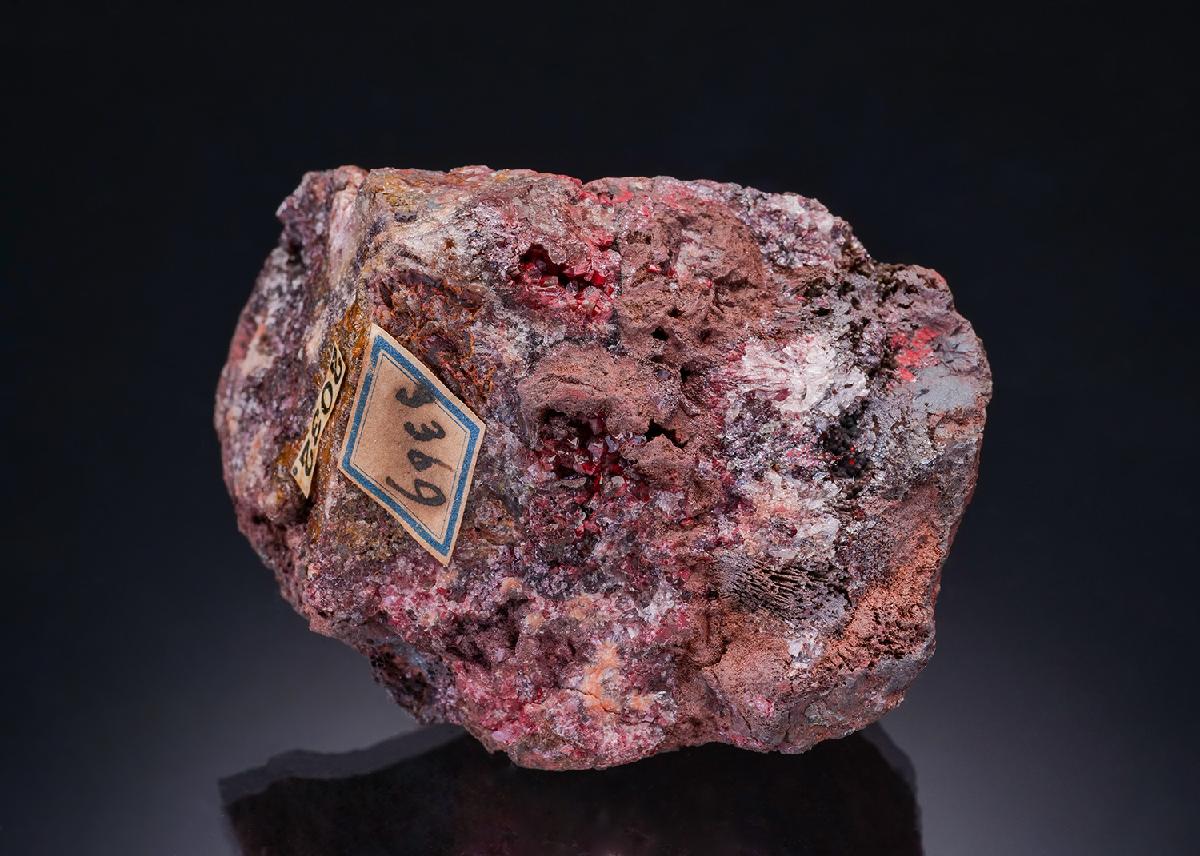
An old-time specimen of Cinnabar with Hollandite and Baryte on Quartz from the ancient mercury mining district close to the town of Wolfstein in Rhineland-Palatinate, Germany, south-west of Frankfurt am Main. Wolfstein in the Kusel district of Rhineland-Palatinate, is within a region rich in mercury and mercury minerals, where mining began in around 1440. Because of mercury's unique property of being the only liquid metal at ambient conditions, it has been known since ancient times, and is thought to have been first discovered by the Ancient Egyptians, prior to 1,500 BCE. Sub-millimetre, bright scarlet to orange-red Cinnabar crystals are scattered over grey Quartz and metallic, dark grey Hollandite in several shallow vug, more like shallow depressions, in a Cinnabar stained, brick red matrix. Small patches of flesh pink Baryte are dotted here and there across the matrix's surface. Cinnabar is mercury sulphide and Hollandite, a complex barium-manganese oxide containing both trivalent (Mn 3+) and tetravalent (Mn 4+) manganese.
52 x 35 x 40 mm