
 0
0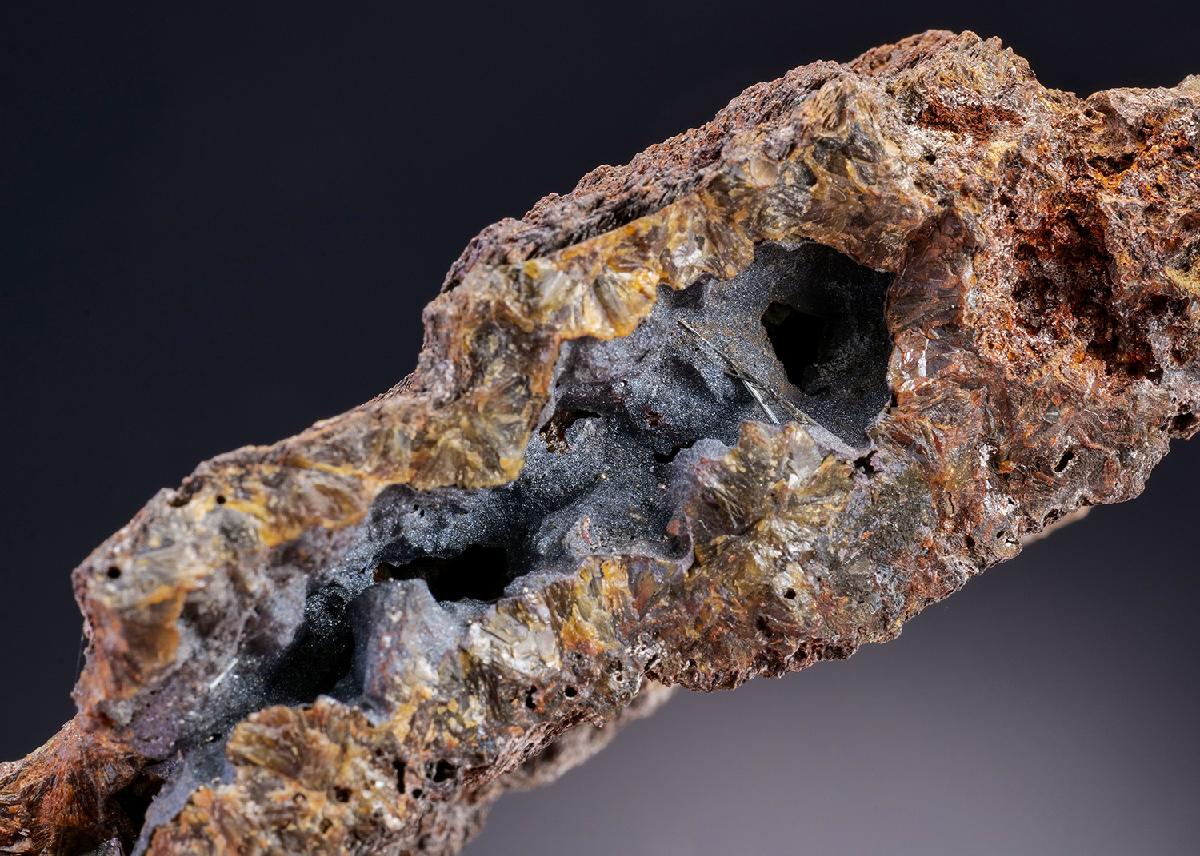
A fascinating combination of Stibnite with Native Mercury and Moschellandsbergite is accommodated within a roughly 5.5 x 1 cm vug along one side of a 8.4 cm long brown matrix of massive and crystallised Siderite. Within the vug the Siderite forms occasional, well developed crystals and either side of the vug forms a hemispherical rosettes of radiating crystals. The entire vug is lined with a thin deposition of greyish-silver Stibnite, probably containing micro-disseminated Native Mercury. Spanning the vug in several places are acicular needle-like Stibnite crystals. The Stibnite, both the crystals and that coating the vug, is punctuated with occasional silver, spherical globules of Native Mercury. Occasionally, the rare silver-white mercury-silver amalgam, Moschellandsbergite, may be seen within the vug, but this is difficult to see and is best observed through a microscope. Moschellandsbergite is an isometric (cubic) mineral and forms highly modified crystals with multiple faces, so much so that individual crystals can look like spheres. In the presence of Native Mercury, forming spheres of a similar size and colour to those of Moschellandsbergite does not make identification of the latter straight forward. However, I find that for some unknown reason the Moschellandsbergite adopts a slight golden hue, so look out for what you may at first think is Native Mercury, but with a subtle golden tarnish. This small cabinet specimen is from the ancient mercury mining district of Landsberg in Rhineland-Palatinate, Germany, south-west of Frankfurt am Main. Moschellandsberg hill (now shortened to Landsberg), is within a region rich in mercury and mercury minerals, where mining began in around 1440. Because of mercury's unique property of being the only liquid metal at ambient conditions, it has been known since ancient times, and is thought to have been first discovered by the Ancient Egyptians prior to 1,500 BCE. For any specimens containing mercury and or mercury bearing minerals, it is a sensible precaution to always wash your hands after handling.
84 x 40 x 24 mm